Table of Contents
ToggleThe Best ADEA PASS Resources Every Applicant Should Know About
If you’ve decided to pursue an advanced standing dental program in the United States, chances are you are already overwhelmed.
One Google search quickly turns into twenty browser tabs. One YouTube video leads to five Facebook groups. Every applicant seems to have different advice, and before long, you’re wondering which information is actually accurate. Nothing looks as simple as it sounds.
The reality is that applying through ADEA PASS is about much more than submitting documents. It’s about making informed decisions, preparing strategically, and finding mentors who can guide you through a process that often feels unfamiliar.
However, the good news is that you don’t have to figure it all out by yourself. At PASS Simplified, we have put together a set of resources that provide you with the exact information you need to arm yourself with before you bite the bullet.
Resources that can save you hundreds of hours of research and a lot of mindspace. Storehouses of information to help you avoid common mistakes and make your application journey much more manageable.
So read on first; you can say thank you later!
1. The Prima Donna – ADEA PASS, the Official Source
We believe that every successful application begins here. At the ADEA PASS site. And we start at the very beginning.
While social media is full of opinions, this is one of the few sources that provides information that actually matters.
The official website of ADEA, the governing body for all residency applications, not only manages the application process but also guides you step-by-step on how to apply. For instance, information about programs, required documents, application instructions, and letters of evaluation are all disseminated through its site. Whether requesting INBDE results or just developing a checklist to ease your anxiety, the site has you covered. Don’t believe us – see it for yourself.
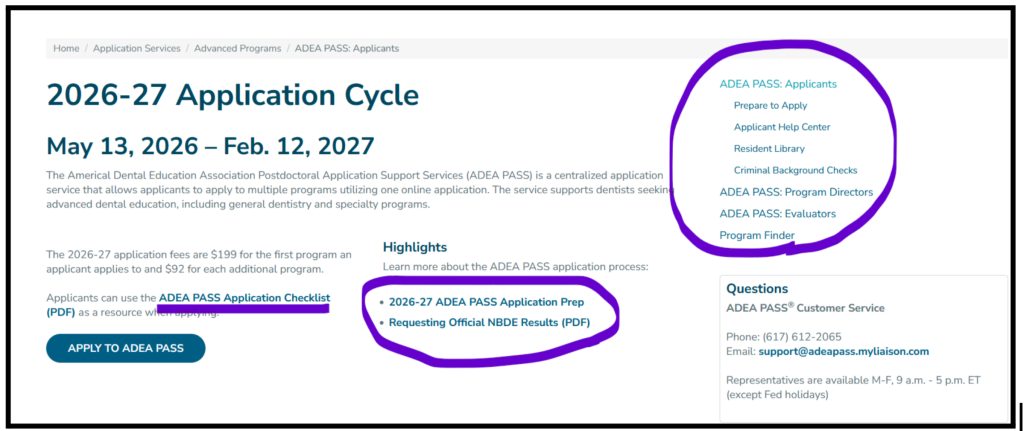
Play around on the website, explore it thoroughly, and you’ll find yourself completely on top of everything you need to know about the application process. In fact, the ADEA PASS Applicant Help Center on the same page sounds like someone answered your SOS call for filling out the ADEA PASS Application Portal!
Something that truly fascinates us is the ADEA PASS Evaluators section – it allows such insight into what program directors really value while reviewing the evaluation forms. It also validates all that we have been clamoring about all these past years regarding what makes a letter of recommendation strong and noteworthy! And this is particularly of interest and informative value to foreign-trained dentists whose recommenders are not always familiar with the expectations from these letters.
However, our favorite part of this site is its Resident Library! What do you mean they have videos of actual residents – across varied specialties – imparting crucial advice on a wide range of topics – from resume-building to interview tips, the evaluation forms, to the MATCH process! We found these videos quite meaningful for all those embarking on this long and lonely residency path, with very few companions or mentors to light the way.
To summarize, your first stop along this winding pathway is the ADEA PASS website. The ultimate handbook for dental residency applications! Be sure you thoroughly explore this while you conduct your primary research, in parallel.
2. The One-Stop Shop for All Program Information – The ADEA PASS Program Finder
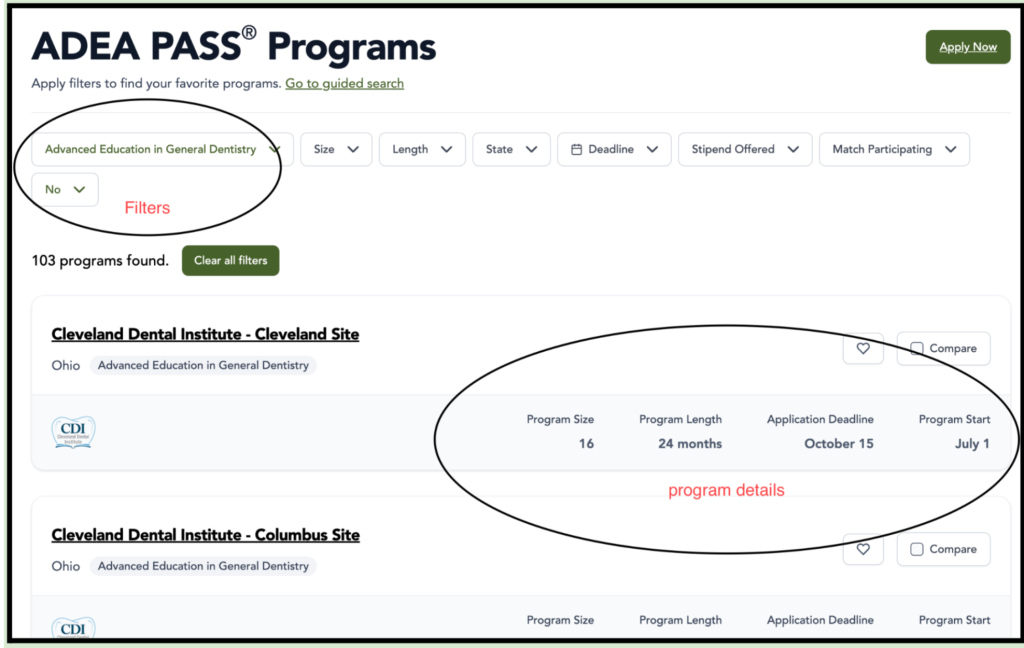
One of the biggest challenges a Residency applicant has to navigate is the sheer volume of program information they need to compile and compare before zeroing in on the exact ones that resonate with their aspirations. Yes, the vast array of options definitely means an increased statistical probability of acceptance, but it is no mean task to sift through all the information. And at that intersection sits one of the most credible aids to help you in your shortlisting process – the ADEA PASS ® Program Finder.
For those of you who are familiar with the CAAPID Process, you may be able to closely relate to the PASS Program Finder. Like in the case of CAAPID, this Program Finder lists the PASS-participating residency programs (825 as of the date of this blog), across all dental specialties offered. And like CAAPID, the filters make your life easier and your decision-making simpler – filters based on choice of specialty, program length, and visa status, among others.
From there, it becomes easier – to further filter out programs according to your eligibility and preferences. And a great starting point to broaden your research about each program.
One shared wisdom from our experience with PASS Applicants from earlier cycles: many applicants make the mistake of relying on what someone posted in a forum months ago. Applicants often do not realize that policies change every cycle.
Hence, let the official website – both ADEA PASS and the individual school’s – be your first stop for information – not your last.
3. The Authentic Sources – State Dental Associations & Dental Boards
We wonder if this should not be ranked higher in this list! Irrespective of the order, this is one resource that should never be overlooked: the dental organizations in the states you’re considering to pursue your residency in.
Why? Because your dental journey doesn’t end with an acceptance from a reputed dental school. It is merely a start. It is quite imperative that you are well aware of what follows next – licensure, regulations, employment, and practicing – before you cast a watertight application. Your future options often dictate your present decisions. This is particularly important in the case of international dentists who do not possess a DDS/DMD degree from a CODA-accredited institution.
These administering bodies and dental associations are not only a great way to get a feel for the dental landscape in a particular state but also an extremely helpful and reliable source of information. They often provide professional resources, local updates, continuing education opportunities, and information that can help you understand what practicing dentistry there looks like.
After all, when it comes to actual licensure requirements, you go to the source of the authority, the actual seat of power. Which is your state dental board – not a Facebook group, a consultant, or even a well-meaning senior who graduated five years ago! For eg., if you are actively considering studying and practicing Orthodontics in California, then the Dental Board of California and the California Association of Orthodontists should be two of the top sources to rely on,
So while researching a residency, spend a little time researching the state too. The question isn’t just “Can I get into this program?” but also “What can I do after I graduate?”
Information worth knowing before you apply, not after.
4. To Match or Not to Match – The Dental Match Website
A very important site, in case you are applying to a residency program that participates in the Match (most AEGD, GPR, Periodontic, Prosthodontic, Pediatric, Orthodontic, and Oral Surgery programs do). It should be on your must-know list early on.
One thing you will get to understand early on is that PASS and the Match are two different processes. PASS is the application service; the Match is an algorithm through which participating applicants and programs are ultimately matched.
And Dental Match website gives you all the information about participating programs, registration, timelines, ranking, and the matching process. Now why is this site important? Because not every school/PASS program participates in Match.
For instance, out of the 67 Orthodontic Programs we found on the Program finder, 8 programs (Loma Linda, Southern Illinois University, and University of Colorado included) do not participate in Match! So if such programs are high on your priority list, then maybe you can save yourself from the additional expense and paperwork of Match.
The corollary holds true too. Whether you consider Match scientific and less ambiguous or do not want to go through that uncertainty are two factors to consider while evaluating programs! And the best source to help you with that decision making, is the website itself.
5. Bookmark – Schools’ Admissions Page
Now, that is basic, right? You are interested in a school’s residency program; you will obviously stalk the school website and keep yourself apprised of its requirements and changing policies, if any, correct? Apparently, not. Often, during our numerous conversations with prospective applicants, we come across one common misconception: that every dental school wants the same set of things.
Unfortunately, they don’t.
Every residency program has its own philosophy, curriculum, and admissions requirements.
For instance, the Endodontics Program at Case Western mandates that all applicants take ADAT as a prerequisite – which is not the case, say, for Endodontics Programs at Boston University or even Harvard. So if Case Western is in your list of preferred schools, you need to be aware of its unique requirement – ADAT!
The only solution: spend time exploring each school’s website, in addition to the ADEA PASS Program Finder details.
Also, we would suggest you read beyond the admissions page. To understand whether the school’s philosophy resonates with you and/or its curriculum aligns with your nature of learning and practice. More often than you would expect, we have heard prospective applicants feeling a lack of connection with the school they applied to/interviewed at – there is a chance you could discover this info upfront and save on resources.
So what should you look at:
- Program Information Brochures
- Press Releases and Media posts, even archives
- Faculty Bios
- Student Commentary and
- Academic Calendar
And what should you look for:
- Research strengths
- Community outreach initiatives
- Specialty clinics
- Clinical philosophy
- Supplemental application requirements
- Interview formats
The more you understand a program and its scope and requirements, the clearer it becomes whether the school aligns with your expectations from the program and overall philosophy. More importantly, it becomes easier to establish that mutual fit – through documents and during interviews.
6. Network – Applicant Communities
The application journey can sometimes feel lonely. PASS in particular, given the vast number of programs, variedness of their requirements, and the competitiveness of the admission process is a more confounding process.
It is why you need applicant communities – they remind you that thousands of dentists around the world are working toward the same dream.
Facebook groups, Reddit communities, WhatsApp spaces, Telegram channels, and Student Doctor Network discussions can provide:
- Candid feedback about programs and student life
- Ground realities about program requirements and implicit selection criteria
- Interview invitation timelines
- Bench test discussions
- Housing advice
- Financial planning tips, and even
- Emotional support
However, treat community discussions as conversations—not facts. And take them with a grain of salt. Always verify important information with the school itself.
On that note, heard of tunnel vision? A little bit of it could actually stand you in good stead during the application process (only)! In other words, it may be helpful to deal with the anxiety of the process to filter out the vast amount of information and negativity that floats around in such communities. Comparing your prospects with other successful applicants more often than not leads to anxiety and a feeling of being caught in a rat race.
7. Invest – Consultancies/Service Providers/Educational Resources
This is, for obvious reasons, the closest to our heart. Keep an eye (and an ear) out for forums that every international dentist should know – like the Student Dentist Network (SDN), and consultancies such as Aspire 32. Yours truly – Caapid Simplified and PASS Simplified – are also veritable databases and contact points that can guide you – during the preliminary research, in the process, and when preparing your documents.
For years, successful applicants have documented their experiences there. Over the years, these providers have amassed experience through secondary research and applicant conversations.
You’ll easily find discussions on:
- Program comparisons
- Faculty interactions
- Application processes
- Drafting documents
- Previous admission cycles
- Interview questions
- Bench test experiences
Reading through these discussions won’t guarantee admission, but will expand your understanding of the application process and what programs value.
Make the most of them.
8. Those Who Have Already Done It – Peers
One thing we probably need not tell you, and you are already doing is – building relationships with current students and alumni. There is tremendous value in listening to people who were in your shoes just a year ago. They have been there, done it, and have viable insights on how to crack the cycle.
Many international and traditional dentists also share their experiences on YouTube and LinkedIn, and via podcasts and blogs. Often, their journeys answer questions you didn’t even know you had. They openly discuss:
- Mistakes they made
- What they would do differently
- Bench preparation
- Personal statements
- Interview strategies
- Financial planning
They can tell you:
- What the culture is really like
- How clinical education works
- Which qualities faculty appreciate
- How they prepared
- What surprised them after joining
Most students are surprisingly willing to help when approached respectfully – as long as it steers clear of stalking! One thoughtful conversation can be more valuable than hours spent searching online. And this may be the most underrated resource of all. Current students understand the program you’re applying to better than anyone else!
Also – point worth remembering – the senior cohort often has a say in who makes it through to the current batch!
9. Uncanny But True – Continuing Education Courses and Conferences
This is an oft-overlooked source for information. Yes, we tend to look at continuing education courses and conferences as tools to showcase our ability to continue learning and growing. Whether it’s the Greater New York Dental Meeting, Yankee Dental Congress, local study clubs, or hands-on workshops, continuing education demonstrates curiosity and initiative.
These events expose you to:
- Digital dentistry
- Emerging technologies
- New materials
- Modern treatment philosophies
However, what we do not fully appreciate is that these are an excellent playing field to network. Scores of applicants have found contacts there which eventually converted into shadowing/assisting/research opportunities. And these are also good conversation starters during interviews!
Plus, schools have booths, so you get info from the horse’s mouth; often, the hosts may remember your name, which is a definite plus when it comes to identifying you during the application stage.
Conferences and CE courses showcase more than a growth mindset; they also mean a shrewd application strategy.
10. Modern Day Mentor/Guide – AI
Not as a substitute for your own research or as your ghostwriter, no, we would not recommend that. Never.
But in a world where AI has come to dominate every single aspect of life, we need to capitalize on its incredible utility. It definitely makes your complex job of searching for information and comparing program information much simpler.
It can help you
- Shortlist programs and evaluate fit
- Collate successful applicant stories
- Analyze documents
- Brainstorm ideas
- Practice interviews
- Generate mock questions
- Understand and assist in completing prerequisites – including INBDE, TOEFL, Bench etc..
A caveat though – AI is best used as a research assistant or as a critic, for dental school admission purposes. The admissions committees have come to be remarkably good at recognizing reality versus fabrication, authenticity versus dramatics.
It can be used to refine your ideas and not replace your voice.
Final Thoughts
Applying to an ADEA PASS residency program is rarely a straight road. There will be moments of uncertainty, long periods of waiting, and times when you question whether you’re doing enough.
That’s completely normal.
The applicants who succeed aren’t always the ones with the highest scores or the longest résumés. More often, they’re the ones who seek guidance, stay consistent, and keep learning even when the process feels uncertain.
Use official resources as your foundation. Learn from those who have walked the path before you. Stay curious. Keep refining your skills. Most importantly, don’t lose sight of the reason you started this journey in the first place.
Every dentist who is now wearing a U.S. residency badge or practicing with confidence once sat exactly where you are today—wondering if their dream was possible. The good news is – with the right preparation, persistence, and support, yours can be too.
And for those of you who need such assistance, or just an empathetic sounding board – you can always count on us.
For, help will always be given to those who ask for it 🙂