
Table of Contents
Toggle1. Introduction: Why Your PASS / Dental Residency CV Matters More Than You Think
Imagine this for a moment: a residency director sits down to review hundreds of applications for a highly competitive specialty program. Before interviews, before emails, and sometimes even before your personal statement gets a careful read, one document quietly begins shaping their first impression of you: your CV for dental residency. Sounds like a lot of pressure? In many ways, it is. But here is something worth remembering right from the start: your PASS CV or dental residency CV is not simply a list of dates, degrees, and experiences placed on paper.
Instead, it becomes your professional story long before you ever speak to a residency program. For international dentists, especially, your CV is often one of the first indicators of clinical readiness, professional direction, and commitment to specialty training. In a short review window, programs are trying to understand not just what you have done, but whether your experiences align with where you want to go.
So, what exactly are residency programs trying to understand when they review your PASS CV? In most cases, they are looking for clear signs of preparation, consistency, and professional direction, including:
- Your academic preparation and educational foundation
b. Clinical experiences relevant to your intended specialty
c. Hands-on training, shadowing, CE courses, and specialty exposure
d. Research involvement, publications, and presentations
e. Community service, leadership, and professional engagement
f. Evidence of long-term commitment, initiative, and professional growth
Now, if you are already familiar with CAAPID applications, here is something reassuring: a PASS CV is not dramatically different from a CAAPID CV. The structure remains similar, but the intent changes. Residency programs are evaluating your readiness for a specific specialty, making specialty alignment and relevant positioning far more important than volume.
In this blog, we will walk through how to structure a strong PASS CV, tailor it to your specialty, prioritize the right experiences, avoid common mistakes, and present your professional journey in a way that feels clear, intentional, and residency-ready.
PASS CV vs CAAPID CV: What Actually Changes?
Many international applicants begin the PASS application process believing they need to build an entirely different CV from scratch. Thankfully, that is usually not the case. PASS and CAAPID CVs share a very similar foundation in structure, formatting, and organization. The main difference is not how the CV looks, but how experiences are prioritized for residency programs.
Similarities Between PASS and CAAPID CVs
Both PASS and CAAPID CVs are expected to be professional, concise, easy to scan, and organized in reverse chronological order. Programs still look for a strong academic background, clinical exposure, and professional involvement.
What generally stays the same?
- Reverse chronological order
- Educational qualifications
- Clinical experiences
- Research and publications
- Continuing education (CE) courses
- Community service and volunteering
- Leadership, awards, and achievements
- Professional formatting and brevity
So, if the overall structure remains fairly similar, what actually changes?
The Biggest Difference: Specialty-Centric Positioning
This is where PASS applications begin to separate themselves from CAAPID applications. A CAAPID CV often benefits from showing broad clinical exposure and a well-rounded dental background. A PASS residency CV, however, is evaluated with one major goal in mind: determining whether your experiences genuinely align with a specific specialty.
What Does Specialty Alignment Actually Look Like?
Let us look at how this works in practice. Imagine an applicant preparing for an orthodontics residency. Their CV should naturally bring forward experiences that consistently reflect orthodontic exposure and long-term interest in the field.
For orthodontics, programs often value:
- Orthodontic shadowing or assisting
- Orthodontic case exposure
- Aligner- or braces-related CE programs
- Orthodontic workshops and seminars
- Faculty mentorship in orthodontics
- Orthodontic research projects
At the same time, unrelated experiences such as general restorative or RCT-focused CE courses may receive less emphasis unless they meaningfully strengthen the overall profile.
Similarly, an endodontics-focused CV should highlight stronger technical and procedural exposure, including:
- Microscopic endodontic exposure
- RCT-heavy clinical experience
- Endodontic CE programs
- Complex case management
- Endodontic publications or research
This does not mean unrelated experiences should disappear entirely from your CV. Instead, the goal is to strategically prioritize specialty-relevant experiences while allowing other experiences to support your overall profile.
Although PASS and CAAPID CVs may look similar structurally, the strategy behind them is different. It should demonstrate why your experiences, interests, and professional direction make sense for the specialty you hope to pursue.
This naturally brings us to the next step:
Planning for a dental residency program in the US?
What are the golden rules of building a strong PASS CV?
Now that we have understood how a PASS CV differs from a CAAPID CV, let us talk about what actually makes a residency CV stand out. The truth is, strong PASS CVs are rarely the longest or the most crowded. Instead, they are strategic, focused, and easy to follow. In fact, our Founder, Dr. Nourah, often emphasizes that an ideal PASS CV is typically around 2 to 3 pages long, proving that quality matters far more than quantity. Residency directors spend limited time reviewing applications, so your CV should make it easy for them to understand your journey, specialty interests, and readiness for residency training. Every section should quietly help answer one thing: why are you a good fit for this specialty? Here are some of the golden rules that can help you build a stronger PASS CV.
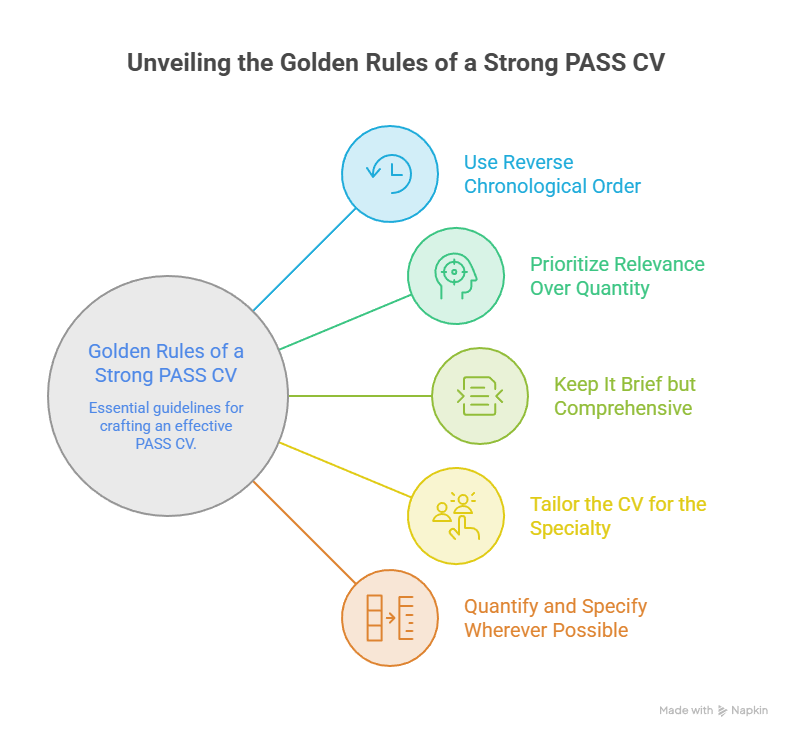
a. Use Reverse Chronological Order: Always place your most recent experiences first, whether they are clinical experiences, research projects, CE courses, or volunteer work. This helps programs quickly identify your latest accomplishments and involvement.
b. Prioritize Relevance Over Quantity: Avoid listing everything you have ever done. If you are applying to endodontics, RCT-heavy clinical experience and endodontic CE courses should receive greater emphasis than unrelated workshops.
c. Keep It Brief but Comprehensive: Strong CVs are concise, organized, and easy to scan. Instead of vague statements, use clear descriptions such as, “Managed 200+ restorative and endodontic cases over two years.” A well-structured CV allows reviewers to quickly identify your strengths without searching through lengthy descriptions. Remember, clarity often creates a stronger impression than excessive detail.
d. Tailor the CV for the Specialty: Different specialties value different experiences. An orthodontics applicant may highlight aligner certifications and cephalometric training, while a pediatric dentistry applicant may emphasize behavior management and school dental camps.
e. Quantify and Specify Wherever Possible: Specific details make your CV stronger and more credible. For example:
Assisted in 200+ endodontic procedures.
Presented research at a national conference.
Led a team of interns during community outreach programs.
Mentored junior students during preclinical training.
When you step back and look at these golden rules together, one thing becomes very clear: a strong PASS CV is not built by chance. It is built with intention, where every experience is thoughtfully presented to tell a meaningful professional story.
4. What Is the Ideal Structure of a PASS Residency CV? (Section-by-Section Breakdown)
Let’s break down the core sections your PASS CV should have, starting with the first thing programs see: your professional header.
Contact Information & Professional Header: Your PASS CV should begin with a clean, professional header that allows programs to quickly identify and contact you. Keep this section simple and easy to navigate.
Also, do not forget to include your contact information. A brief professional summary highlighting your qualifications, strengths, and career interests can be a valuable addition if you have the space and can keep it concise. Avoid including unnecessary personal details such as age, marital status, religion, passport information, or photographs.
Example:
Dr. Riya Malhotra | Chicago, Illinois, USA
riyamalhotra.dds@gmail.com | +1 (312) 555-4821 | http://linkedin.com/in/drriyamalhotra
Internationally trained dentist with clinical experience in comprehensive dental care and a strong interest in specialty training.
Educational Qualifications: Start this section with your most recent degree first, following reverse chronological order. Include your dental degree(s), institution name, location/country, and graduation timeline (start date to end date). If your GPA is strong, you can mention it to strengthen your academic profile. If you have completed an additional degree such as an MPH, MHA, MSc, or MBA, you can absolutely include it, but it should come under Academic Qualifications rather than being grouped with your dental degree.
Example:
- Indraprastha University of Dental Sciences
Doctor of Dental Surgery (DDS) | Delhi, India Aug |2014 -Jun 2019 | GPA: 3.8
Professional Experiences: Always organize this section in reverse chronological order, beginning with your most recent role first. Ideally, separate this section into U.S./Canadian Dental Experience, International Dental Experience, and Non-Dental Experience for better readability. For PASS applicants, specialty-related experiences should naturally appear more prominently.
Example:
US/Canadian Dental Experience
Dental Assistant
Smile Esthetics Prosthodontics |Texas, USA| Jan 2024 -Present
a. Assisted in crown preparations, implant restorations, and digital impressions.
b. Supported prosthodontic consultations and laboratory coordination.
Community Service & Outreach: This section can include dental camps, oral health awareness programs, rural outreach, volunteer initiatives, and healthcare-related service activities. Residency programs value applicants who demonstrate compassion and a willingness to serve communities beyond the clinic, as it reflects professionalism and commitment to patient care.
Example:
Community Health Volunteer, Texas, United States | Jun 2025 – Present
Supported patient navigation, assisted families with healthcare resources, and participated in wellness engagement activities at a regional healthcare center.
- Research & Publications: Kindly make it a point to include your research work, as residency programs generally appreciate applicants with a research-oriented profile. While research is certainly not a non-negotiable, and we have seen many applicants with little or no research receive interviews, it does demonstrate analytical thinking, intellectual curiosity, and commitment to evidence-based dentistry. Even non-dental research can be worth mentioning if it reflects meaningful skills or contributions.
Example:
Patel, R., Sharma, K. Digital Smile Design in Prosthodontic Rehabilitation. Journal of Clinical Dentistry. 14(2), 22-29 (2024). https://doi.org/10.5678/jcd.2024.221
Presentations: This section can include poster presentations, paper presentations, seminars, and scientific meetings. These experiences help showcase academic engagement and a willingness to contribute to professional discussions.
Example:
a. Presented poster on “Implant-Supported Prosthetic Planning” at the Indian Prosthodontic Society Conference, Delhi, India | Nov 2022
b. Attended Greater New York Dental Meeting, New York, USA | Dec 2023
- Miscellaneous: Anything that you have pursued in addition to your academic and clinical experiences can find a place here. While these experiences are not deal breakers, they can certainly give you a slight edge over your peers and help differentiate your profile.
This section may include:
- Conferences and seminars
- Paper or poster presentations
- Professional associations and memberships
- Certifications and licenses
- Additional training or recognitions
Do remember to include the time frame, venue, and organizing authority wherever applicable.
Examples:
- Member, American Dental Association (ADA) | 2023 – Present
- Basic Life Support (BLS) Certification | American Heart Association | 2024 – 2026
- Advanced Clear Aligner Therapy (12 CE Credits) | University of Southern California | Mar 2024
- Recipient, Outstanding Postgraduate Research Award | Manipal College of Dental Sciences, India | May 2022
5. Specialty Examples: How to Tailor Your PASS CV
At this stage, many applicants start wondering: “How exactly do I tailor my CV for a specialty?” The answer is often much simpler than people expect. You do not need to completely reinvent your background for every residency application. What residency programs really want to see is alignment. The way you organize your experiences, continuing education, research, and even volunteering should quietly show why your background makes sense for the specialty you are pursuing.
Let us look at what that actually means in practice.
If You Are Applying to Orthodontics
Orthodontic programs often look for evidence of sustained interest in orthodontic treatment planning, appliance systems, and long-term patient care. If you have completed orthodontic shadowing, workshops, research, or aligner-related training, those experiences should naturally move higher in your CV.
For example, this order:
Associate Dentist → RCT Workshop → Restorative CE → Orthodontic Shadowing
Could become:
Orthodontic Clinical Observer → Clear Aligner CE → Orthodontic Research → General Dentistry Experience
A stronger orthodontic profile may include experiences such as:
Clinical Observer
Precision Orthodontics, Texas, USA | Jan 2024 – Present
Observed aligner treatment planning and bracket placement
Assisted in orthodontic documentation and case discussions
Followed patient progress through retention stages
You can also pair this with CDE Courses like:
Clear Aligner Biomechanics (10 CE Hours)
University of Michigan | Apr 2024
Restorative dentistry experiences do not need to be removed, but they can be shortened and positioned below orthodontic-specific experiences.
If You Are Applying to Pediatric Dentistry
Pediatric dentistry programs often value communication, behavior management, and comfort working with children and families. Experiences involving school outreach, oral health education, and pediatric patient interaction deserve greater visibility.
Volunteer Oral Health Educator
Healthy Kids Outreach Program, California, USA | Jun 2023 – Nov 2023
Conducted oral hygiene sessions for school-aged children
Assisted with preventive screenings in community schools
Educated parents on childhood oral health habits
Pairing this with:
Behavior Management in Pediatric Dentistry (8 CE Hours)
Boston University | Mar 2024
can strengthen the overall pediatric narrative. Meanwhile, highly technical implant or prosthodontic experiences can be shortened and moved lower in the CV.
6. What Can Weaken Your PASS CV? Common Mistakes to Avoid
Before submitting your PASS CV, it is just as important to know what to avoid as it is to know what to include. Many strong applicants unintentionally weaken their CVs by overcrowding them, formatting inconsistently, or adding details that residency directors simply do not prioritize. A clean, focused CV almost always leaves a stronger impression than one trying to say too much.
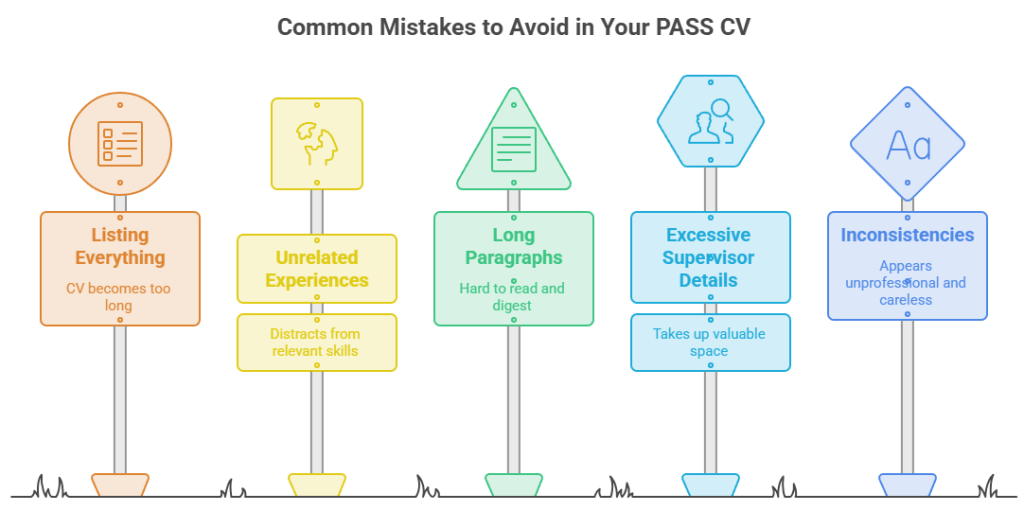
Don’ts
- List everything you have ever done. Your CV is not your life story. For example, an orthodontic applicant does not need to equally emphasize every unrelated restorative CE course from five years ago.
- Overload unrelated experiences. Not every observership deserves the same space. Prioritize what strengthens your specialty profile.
- Long descriptive paragraphs. Residency directors prefer concise bullet points over dense descriptions.
- Excessive supervisor details. Listing supervisor emails, phone numbers, and long references can create clutter unless specifically requested.
- Formatting and grammatical inconsistencies. Multiple fonts, uneven spacing, different bullet styles, or misaligned dates can make a CV feel rushed and difficult to review. Also, proofread carefully for spelling errors, grammatical mistakes, and inconsistent verb tenses, as small errors can leave a poor impression.
- Final PASS CV Checklist Before Submission
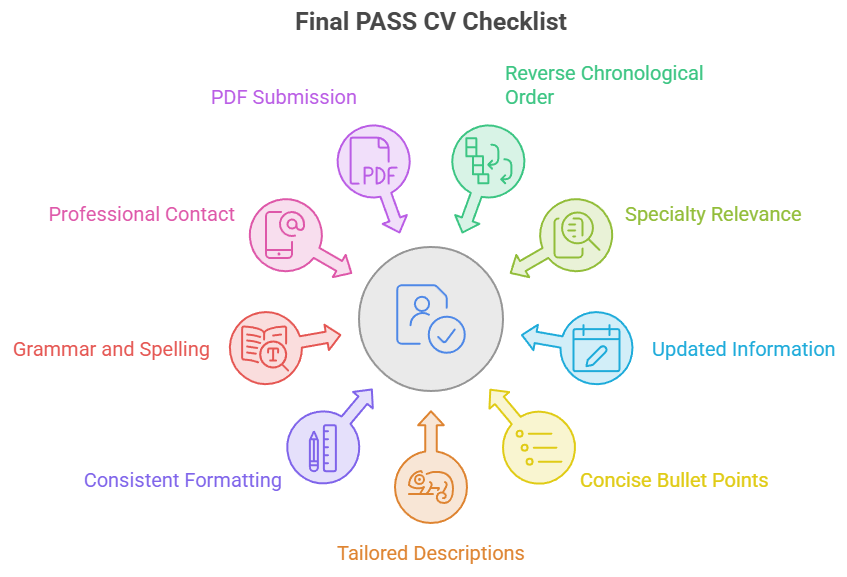
Your PASS CV may look complete, but a quick final review can often make the difference between a polished application and one that feels rushed. Small details matter more than most applicants realize. Let us have a quick look at a few practical things worth reviewing before you hit submit.
- Keep experiences in reverse chronological order unless otherwise specified.
- Prioritize specialty-relevant experiences and economize on unrelated work.
- Update research, publications, and CE courses with accurate dates and credentials.
- Remove unnecessary clutter and avoid overcrowding the CV with unrelated experiences.
- Tailor descriptions for your specialty, rather than using one generic CV for every program.
- Use concise bullet points instead of paragraphs to improve readability.
- Keep professional contact information updated, including email and phone number.
- Maintain consistent formatting, including fonts, spacing, dates, and bullet styles.
- Review grammar and spelling carefully, especially clinical terminology.
- Save and submit your CV as a clean, professional PDF to preserve formatting.
8. Conclusion
A strong PASS CV is rarely the longest one in the application pool, and that is often what surprises applicants the most. What truly stands out is a CV that feels intentional, focused, and thoughtfully organized. At the end of the day, residency programs are not simply reviewing a list of experiences, CE courses, or observerships. They are trying to understand something much bigger: Does this applicant genuinely look prepared for this specialty?
Your PASS CV should quietly answer that question. Instead of documenting everything you have ever done, focus on building a professional narrative that makes sense for your residency goals. Prioritize specialty-relevant experiences, stay concise, highlight meaningful growth, and organize your journey in a way that feels coherent. The strongest CVs often tell a story of direction, not just activity.
Remember: A great PASS CV does not just showcase where you have been; it confidently points toward where you are meant to go.
Also Read:-