
Every dental specialty has a signature.
Prosthodontics rebuilds.
Oral surgery removes.
Orthodontics straightens.
Endodontics saves.
Endodontics is the specialty of second chances, where precision overpowers speed, and outcomes are defined to the millimeter. Long after a tooth has been written off and all signs point to extraction, endodontists pose a different question: “Can this tooth still be saved?”
Endodontics thrives in the space between a lost tooth and a tooth that stays.
Endodontics Residency in the USA means stepping into one of the most intellectually stimulating, financially rewarding, and technologically dynamic avenues in dentistry.
If you are an internationally trained dentist with eyes set on the path of Endodontics Residency in the USA, or curious to know what the road ahead looks like to becoming an endodontist in the US, this blog is for you.
The blog attempts to walk you through everything you need to know, from where to train, what it costs, what your career would look like, and whether this is a path meant for you.
Let’s dig deeper dive right in!
Table of Contents
Toggle1.Endodontics Residency is More Than Root Canals
Say “Endodontics” out loud in a room, and someone will mention root canals. An association so ingrained that the entire specialty has almost been defined by a single procedure, one that barely scratches the surface of what endodontists do.
The American Association of Endodontists (AAE), the specialty’s governing body with over 7400 members globally, describes endodontists perfectly: the leading advocates for natural dentition in the dental profession. Clinicians committed to understanding biology in extraordinary depth and invoking remarkable precision to intervene when every decision can determine whether a tooth can be saved.
That philosophy is truly what Endodontics represents at its core: preservation over replacement, complexity welcomed rather than avoided, a commitment to giving the natural tooth every chance. It is this very mindset, coupled with the clinical expertise, that is the culture you are stepping into. And honestly? It is a good community to be a part of.
A Different Road – PASS or CAAPID?
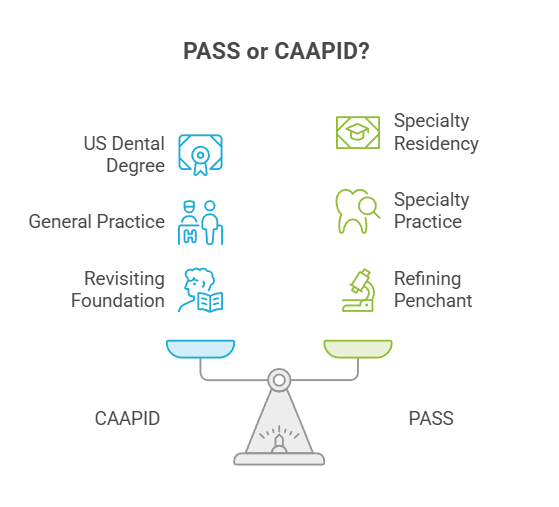
A question that crosses the minds of 48 out of 510 international dentists is: “Should I pursue a DDS/DMD through CAAPID or should I apply directly to a specialty residency through PASS?”
The two are often compared, but they are built to lead you to two different destinations.
CAAPID gives you a US dental degree and license, opening doors to general practice and, later, specialty practice, should you choose it. For several internationally trained dentists, it promises a broad range of opportunities, but it also means returning to dental school and revisiting the foundation you’ve already built.
PASS, on the other hand, begins with a slightly different assumption. That you’ve already set eyes on that one aspect of dentistry that keeps pulling you back. Your calling.
You spend your residency refining that one penchant in extreme depth, learning not just how to master procedures and clinical skills, but also how to shape your mindset and thinking like a specialist in that field.
The truth is that neither pathway is “universally better than the other”. One broadens your options, one deepens your expertise with a focus.
The right choice comes down to a simple question: Are you still exploring your future in dentistry, or have you already found it?
3. The Real Deal – What Does a Residency in Endodontics Require?
At PASS Simplified, we encourage applicants to evaluate their specialty choice for endodontics through two different yet equally crucial lenses: Application and Aptitude
- Application – crafting a compelling PASS application that showcases your clinical competencies, experiences and readiness for an endodontics residency.
- Aptitude – the type of clinician you are, what excites you about endodontics, whether your personal qualities and way of thinking align with the specialty.
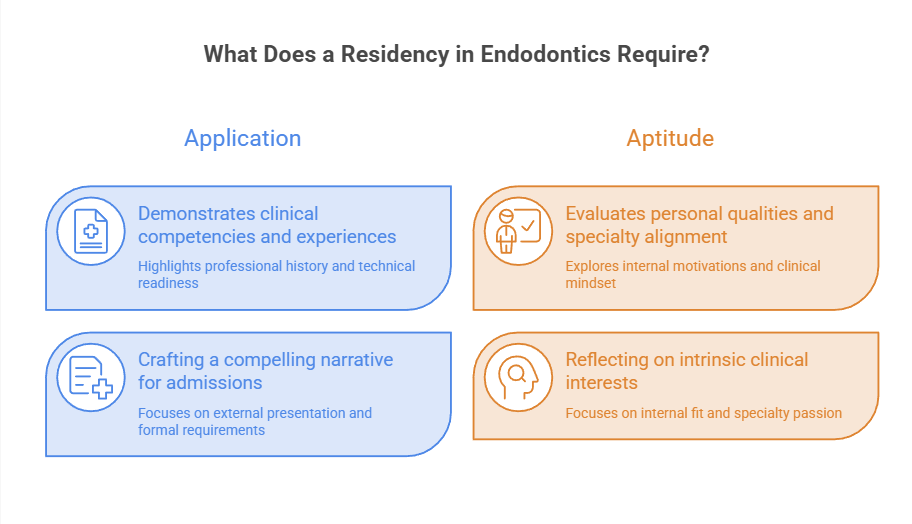
When it comes to your application, the paperwork is non-negotiable, but its important to remember that residency programs are evaluating more than your CV. They are looking for clinicians and people whose interests, mindset and story align with the specialty.
- The Application Lens
Endodontics applications are submitted through ADEA PASS– the centralized Postdoctoral Application Support Service. This is a standardized platform that allows international dentists to apply to multiple residency programs. The requirements include:
- A DDS/DMD or an international equivalent degree;
- TOEFL for graduates of non-CODA accredited schools;
- INBDE
- ECE/WES credential evaluation for internationally educated dentists
- Application Documents- Evaluation Forms, CV, Personal Statement.
Yes, endodontics can be genuinely competitive. With small cohorts of 2-5 residents per year, programs are on the lookout for academic proficiency, real clinical experience, and a very real, specific, not generic interest in endodontics. Ask yourself this one question before you begin, “Can I convincingly explain why I want Endodontics and no other specialty?” If yes, you are already off to a great start. If not, that is the answer your application needs to focus on.
- The Aptitude Lens
Endodontics values the diagnostic thinker
Most specialties present a fairly visible problem. A missing molar. Bleeding gums. Misaligned teeth.
The endodontic patient doesn’t arrive with an obvious problem when you look at them.
They arrive with just one word: pain
Everything else is yours to uncover: which tooth, what is the diagnosis, and finally, is the tooth worth saving?
This is where dentistry demands more than just precision. It asks for attention to detail, to detect the issue, and the patience to work until you find a solution. It is almost like detective work where the careful art of diagnosis is almost as satisfying as the treatment itself. Which is why, to be an endodontics resident, schools look for dentists who find this process energizing rather than exhausting. Those are the people who thrive in endodontics and not just survive.
You believe that the best tooth is the one the patient gets to keep
If you ask a room full of endodontists why they chose this specialty, you’ll probably hear a variety of reasons and stories. But a common thread that ties it together is one philosophy: “Preserving what can still be saved.”
Saving a tooth that was one dental appointment away from extraction, watching it heal, regain function, and continue serving a patient for years is what keeps most endodontists glued to this field. This commitment to preserve isn’t just an endodontist’s job; it is how they think.
Precision and Innovation drive you
CBCT. NiTi rotary systems. AI-assisted diagnosis. Microscopes. Guided access cavity preparation using 3D-printed surgical templates. Bioceramic sealers.
If reading that list sparked curiosity in you, rather than confusion, you’re already thinking like an endodontist. Endodontics embraces technology and grows with it. If you enjoy refining your craft and building on a solid base, then this is the right fit for you.
But beyond all these inherent penchant and talk of qualities that make you well-suited for endodontics, if you want to really know what residency in Endodontics is like, the ADEA PASS Resident Library is a gold mine. It features two Endodontics residents and their insights.
One resident at Boston University shares practical advice on managing the rigorous demands of residency, while another resident at UIC talks about thoughtful pointers to keep in mind while securing your letters of recommendation. This will give you an honest glimpse into what your life could look like in an Endodontics residency program.
4. Who Can Apply?
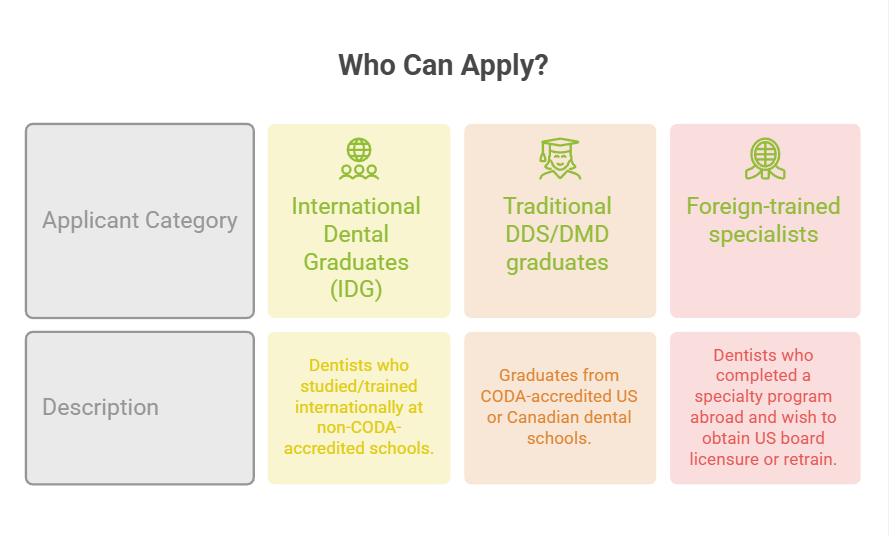
Endodontics Residency Programs in the US are open to 3 categories of applicants:
- International Dental Graduates (IDG)
Dentists who studeid/trained itnernationally, that is, outside the US at non-CODA-accredited schools. This is an existing pathway one can navigate, but it requires careful homework. There are many programs that welcome international applicants. Programs like UT Health Houston, UConn, and UCLA actively consider IDGs. There are, however, a small section of programs like the Dental College of Georgia at Augusta University that are restricted to US Citizens or permanent residents. Navigable, doable, but know your terrain before you apply.
- Traditional DDS/DMD graduates from CODA – accredited US or Canadian dental schools, typically applying directly after their DDS/DMD program, or a year after AEGD/GPR experience.
- Foreign-trained specialists – dentists who completed a specialty program abroad and wish to obtain US board licensure or retrain within the US dental system. Requirements vary extensively from program to program, so once again, check the school’s eligibility thoroughly.
5. The Finer Details- What Does an Endodontics Residency Entail?
Getting in is one thing. What happens once you are inside is another story entirely. According to the ADEA PASS Program Directory, there are approximately 47 accredited Endodontics programs across the U.S.- a far wider landscape than most international dentists realize when they first start looking.
According to the ADEA PASS Program Directory, there are approximately 47 accredited Endodontics programs all across the US. This is infact, a much wider landscape than you realize once you start digging deeper.
The American Association of Endodontics (AAE) also holds its own searchable program directory that you can filter state-wise.
The ADEA PASS Program Directory and AAE are your best friends. Bookmark them both, we promise you will return to them more than once.
Program Size
Most programs accept two to five residents per year. Even larger programs like Penn, NYU, and USC cap their cohort size at 8 or 11. The competition is definitely tight, but the training is incomparable. These are not your lecture hall, classroom residencies restricted to academics. You are in an operatory, handling complex cases right from the first year, under supervision and mentorship. You will know your faculty, and they will know you. In a specialty built on precision and mentorship, that intimacy is not incidental- it is the point.
Program Duration
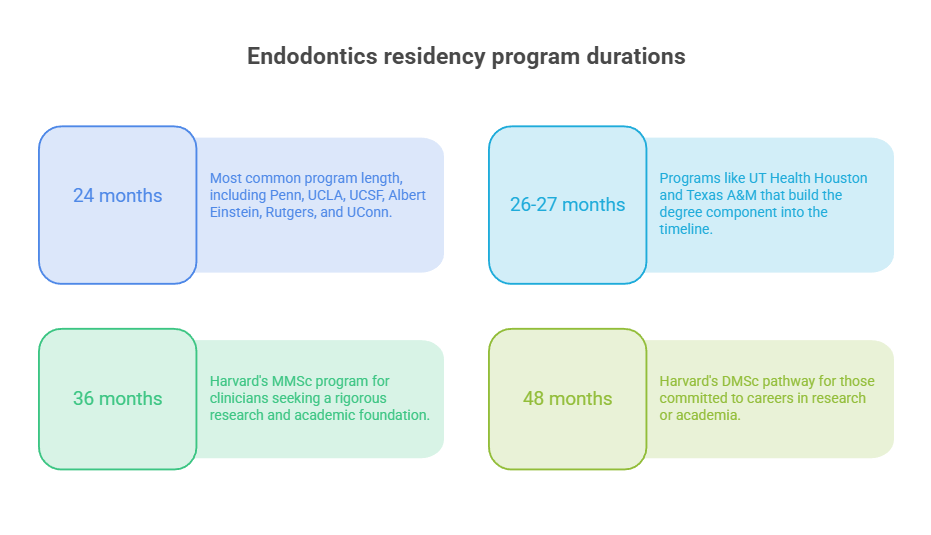
Most endodontics residencies span over 24 months. Two rigorous, endodontics-focused years. Some programs do extend to 26 or 27 months, typically those that have a Master’s degree integrated. Here is a breakdown of some of the programs and their duration:
- 24 months– This is the most common length of a program.
Programs include: Penn, UCLA, UCSF, Albert Einstein, Rutgers, and UConn
These programs are certificate only, or, certificate plus a Master’s, depending on the institution.
- 26-27 months – Programs like UT Health Houston (26 months, MSD) and Texas A&M (27 months, Certificate + MS) build the degree component into the timeline.
- 36 months- Harvard’s MMSc program, designed for clinicians who want a rigorous research and academic foundation alongside specialty training
- 26–27 months — programs like UT Health Houston (26 months, MSD) and Texas A&M (27 months, Certificate + MS) build the degree component into the timeline
- 36 months — Harvard’s MMSc program, designed for clinicians who want a rigorous research and academic foundation alongside specialty training
- 48 months — Harvard’s DMSc pathway, for those committed to careers in research or academia
One thing worth keeping in mind as you compare: a longer program almost always means more tuition, not more stipend.
What Clinical Training Looks Like
Clinical training in Endodontics is deliberately progressive — foundational cases in year one, complex tertiary referrals by the time you graduate. From early in your training, most programs include after-hours emergency care rotations. Real decisions, real pressure, from the start.
Your early months of training at most programs would look like:
- Non-surgical cases
- Retreatments
- Surgical Endodontics
- Trauma
- Rotational after-hours emergency care
Every resident, at an accredited program, is given their own dedicated operatory with a video-capable microscope. This is all yours, not borrowed or shared.
When one thinks of endodontics residency programs, Penn Dental holds a special place historically. It is considered the birthplace of modern endodontics, where the program was established by Dr. Louis Grossman- regarded as the “Father of Modern Endodontics”. As of today, Penn runs 20 fully equipped microscopic units, one for each resident. Similarly, CBCT is integrated both technically and clinically- the clinical judgment to discern when it affects treatment planning.
You often hear that endodontics involves a lot of clinical volume. To get a sense of what serious clinical volume looks like- Ohio State’s program logged over 1,500 emergency patients and 7,350 patient visits across 8 residents in a single year! Patient and clinical exposure is a valuable factor to consider while shortlisting your schools/programs, and clinical volume is definitely worth enquiring about.
Didactics, Research and the big question of Master’s
The academic rigor is real. Seminars, journal clubs, case presentations, and biomedical coursework all run in parallel with clinical training in an endodontics residency. Most programs ask for a formal research project, while others require a written thesis or manuscript prior to graduation.
Which leads us to the one question we hear all the time- “Certificate only? Or, Certificate + Master’s?”
The certificate is sufficient for private practice, and the majority of residents take that path. The master’s degree — MSD, MS, or MMSc depending on the institution — adds a research thesis component and matters most if academia or teaching is somewhere in your future. Our honest take: ask yourself one question — would I want to teach someday? If the answer is yes, even a quiet yes, the master’s track is worth it.
Programs like Harvard, Michigan, and Boston University lean heavily toward the master’s track. Penn, Rutgers, and Albert Einstein offer certificate-only pathways. Most programs on ADEA PASS clearly list what they offer — it is one of the first filters to apply when you shortlist.
Fees and Stipend — The Honest Answer
Here is something that catches people off guard. Most Endodontics programs charge tuition. Unlike AEGD or GPR programs — typically hospital-based, typically stipend-bearing — most Endodontics residencies are school-based. That means fees, not paychecks. Better to know now than to be surprised later.
Tuition typically runs $30,000 to $80,000 per year. Some programs go higher — University of Pittsburgh charges approximately $58,000 per year in tuition alone, with total estimated annual costs around $98,000. UConn runs approximately $22,872 in tuition and fees per year, for a total estimated program cost around $46,796.
A few programs offer partial relief worth knowing about. Ohio State provides a stipend of $16,092 for 2025–26 with half of tuition waived. The Dental College of Georgia at Augusta University is the rare gem — a stipend of $4,200–$4,800 annually with no tuition fee for the certificate pathway, in a city with a genuinely low cost of living. One caveat: Augusta is currently restricted to U.S. citizens and permanent residents.
Our honest summary: Endodontics residency is a meaningful financial investment. Not as steep as a full Advanced Standing DDS/DMD — but real, and compounding over the length of the program. Go in with your eyes open, especially as an international dentist where living costs and program fees can add up faster than expected.
6. Which Schools Offer Endodontics Programs?
The AAE’s Advanced Programs in Endodontics directory lists every accredited program searchable by state — bookmark it today. The ADEA PASS program finder gives you the full picture: cohort sizes, duration, degree offerings, and individual requirements for each institution.
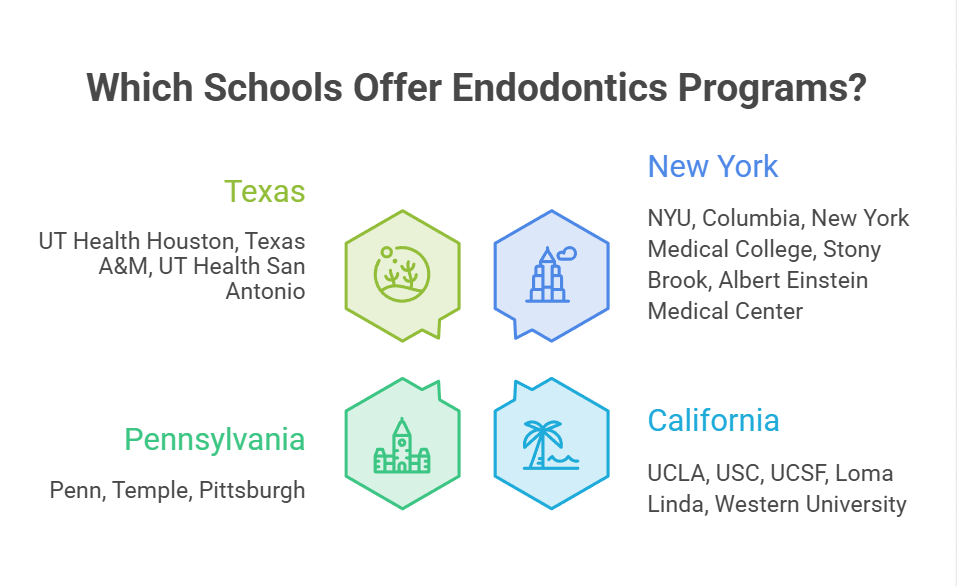
Programs cluster most strongly in:
- New York — NYU, Columbia, New York Medical College, Stony Brook, Albert Einstein Medical Center
- California — UCLA, USC, UCSF, Loma Linda, Western University
- Pennsylvania — Penn, Temple, Pittsburgh
- Texas — UT Health Houston, Texas A&M, UT Health San Antonio
Rather than listing every program — the PASS finder does that far better than we can — here is what actually matters when you are shortlisting: how programs differ from each other, and which kind suits you.
If research and academia are your goal: Harvard’s three-year program is built specifically for this track. The DMSc pathway is for people who are serious about academic careers, not just curious about them. Michigan, Penn, and UCSF maintain similarly strong research cultures — Penn requires every resident to complete an independent research project and present it at the AAE Annual Session. That is a credential, not a checkbox.
If clinical volume and complexity are your priority: Ohio State is the standout — over 7,350 patient visits and 1,500 emergency cases per year across eight residents. If you want to leave residency having seen everything, this is the kind of program that makes that possible.
If a hospital environment appeals to you: Albert Einstein Medical Center in Philadelphia is one of the first ADA-approved hospital-based Endodontics programs in the country. Residents there regularly manage medically complex patients — the kind you rarely encounter in a dental school setting. If you plan to practise near or within a medical institution, the exposure here is genuinely different.
If you are an international dentist specifically: UCLA’s program explicitly considers IDGs and integrates interdisciplinary collaboration with the Ronald Reagan UCLA Medical Center. UConn and UT Health Houston are similarly IDG-friendly. Verify current policy directly on ADEA PASS — always.
7. The Path Ahead – What After Residency?
Here is something we genuinely love sharing with applicants: the demand picture for endodontists in the U.S. is not just good — it is growing, and it is resilient in a way that makes this specialty a particularly sound long-term choice.
An AAE-commissioned report analysing comprehensive insurance claims data found something worth sitting with. While general practitioners have expanded their footprint across several areas of dentistry, Endodontics has remained firmly in specialist hands. Endodontists are not just holding ground — they are gaining patient share. Nearly two-thirds of retreatment cases — among the most technically demanding procedures in dentistry — are handled by endodontists. The conclusion from the data: the endodontist’s role is not being diluted. It is becoming more defined.
For a real-time view of what that demand looks like on the ground, spend fifteen minutes on the AAE Endo Careers job board — which is exactly what we did while writing this. Active listings span Tennessee, New York, Florida, Pennsylvania, Delaware, Georgia, and beyond. Earning potentials of $300,000–$500,000 are common. Sign-on bonuses of $10,000–$25,000 appear across multiple postings. Partnership tracks are routine. This market is actively hiring.
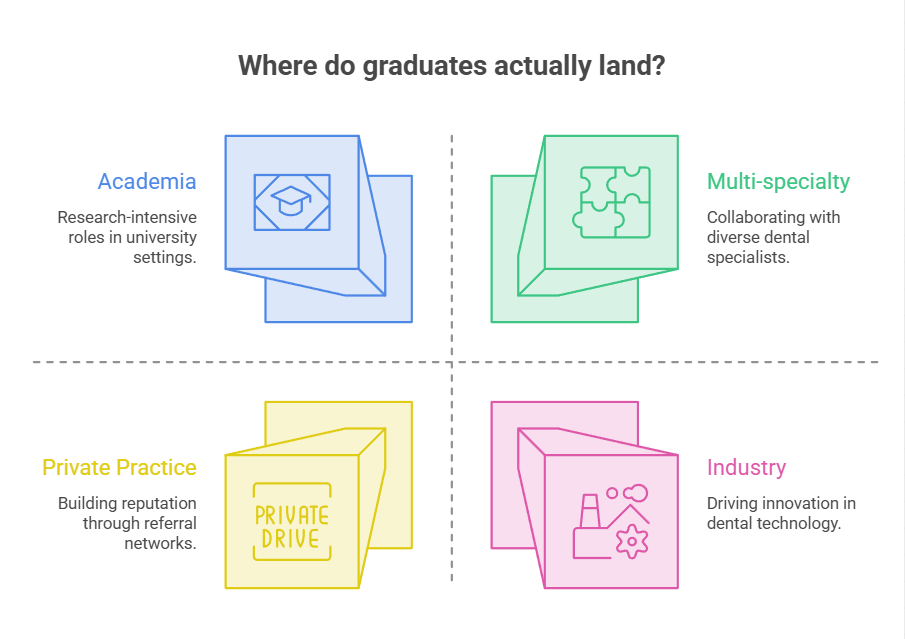
So where do graduates actually land?
Private practice is the most well-trodden path — associates in established endodontic offices, building toward partnership or independent practice over time. The referral-based model rewards reputation and consistency. Your success, genuinely, depends on the GPs who trust you with their hardest cases.
Multi-specialty group practices are a growing part of the landscape. Endodontists working alongside oral surgeons, periodontists, and prosthodontists under one roof — collaborating on complex full-mouth cases — is an increasingly common and financially rewarding model as dentistry continues to consolidate.
Academia is a natural fit for residents from research-intensive programs. Harvard, Penn, and Michigan graduates regularly move into faculty positions, program directorships, and research roles. Complete a master’s or doctoral degree alongside residency and this door opens considerably wider.
Industry is the emerging path worth knowing about — not the most traditional, but real. Companies developing endodontic instruments, bioceramic sealers, CBCT systems, and AI-powered diagnostic tools are actively looking for clinical endodontists who bring genuine expertise. The intersection of clinical credibility and innovation is exactly where this specialty is headed.
8. Earning Estimates
Endodontics is consistently among the highest-compensated dental specialties in the U.S. — and this is one of those cases where the reputation actually matches the reality.
Early-career associates typically earn $200,000–$250,000 per year. Experienced practitioners in established practices earn $300,000–$400,000. Practice-owning endodontists — particularly in markets where specialist coverage is limited — regularly exceed that. The AAE Endo Careers board, which we checked while writing this, lists active positions with stated earning potential of $300,000–$500,000, with sign-on bonuses and partnership tracks on top.
Two variables dominate outcomes more than anything else: ownership and geography. An employed endodontist has predictable income, benefits, and no operational overhead. A practice owner takes on variability and responsibility — but the long-term ceiling is substantially higher. On geography: California, New York, and Massachusetts pay more in absolute numbers, but rural and suburban markets — where specialist coverage is thin and referral competition is lower — often outperform crowded urban settings on per-clinician earnings, even after adjusting for cost of living. Sometimes, the less obvious market is the smarter one.
For the most current picture of what practices are actually paying, browse the AAE Endo Careers board directly — not just for salary benchmarks, but to understand the geographic spread of demand and what employers are genuinely looking for in 2025.
9. A Gentle Reminder: Licensure and Board Certification
Residency ≠ Licensure
We raise this with every international dentist we work with at PASS Simplified — early and clearly — because it is one of those details that can quietly derail a very good plan. Completing an Endodontics residency in the U.S. does not automatically grant you the right to practise in any state. Dental licensure is state-specific, and the rules for IDGs vary significantly depending on where you want to build your career.
In most states, a specialty residency alone does not satisfy the educational requirement for a full dental licence if your original degree is from a non-CODA accredited school — most still require a U.S. DDS or DMD. However, a meaningful number of states have created specific pathways for international dentists. States like Texas, New York, Connecticut, Michigan, and Washington permit IDGs who complete a CODA-accredited specialty residency of at least two full-time academic years to sit for a clinical licensure examination. Texas, for example, explicitly allows this for foreign dental graduates who have completed an ADA-approved specialty program.
The practical implication — and this is the piece we want you to carry with you: where you plan to practise should shape which programs you apply to. Not the other way around. This is one of the first questions to answer, not the last. Confirm current requirements directly with your intended state dental board, because these rules do change.
The American Board of Endodontics
The American Board of Endodontics (ABE) is the only ADA-recognised certifying board for the specialty. Board certification is not required to practise — but it is widely regarded as the mark of clinical excellence in Endodontics, and more practices and academic institutions are factoring it into hiring decisions.
The Diplomate examination involves a written qualifying exam, clinical case submissions, and an oral examination reviewed by board-certified endodontists. Programs like Penn, UCLA, and Texas A&M explicitly design their curricula around ABE eligibility. The College of Diplomates of the ABE offers mentorship throughout the process — which makes it considerably more approachable than it sounds on paper. Worth pursuing, if you have the ambition for it.
Conclusion
Endodontics is a specialty that does its most important work quietly — under a microscope, in the narrow margins between saving and losing a tooth, in the relief on a patient’s face when they learn the tooth can stay.
What endodontists bring home at the end of the day is not a before-and-after photo. It is something more durable: a tooth still there, still functional, still the patient’s own.
That is not a small thing — and endodontists know it better than anyone.
If you are precise by nature, genuinely excited by technology, drawn to diagnostic complexity, and moved by the idea that a natural tooth is worth every reasonable fight — this might be the specialty that fits you best. The training is rigorous. The investment is real. The competition is stiff. But the career on the other side is strong, the demand is growing, and the work is the kind that stays with you.
Start with the ADEA PASS Program Finder and the AAE’s program directory. Browse the Endo Careers board to see what the market looks like right now. Watch Dr. Gandhi and Dr. Yang in the ADEA PASS Resident Library to hear from people already inside programs. And when you are ready to talk through your own path — we are here.
In a profession increasingly capable of replacing teeth, Endodontics remains devoted to preserving them.