CAAPID and PASS are both different routes a foreign-trained dentist could choose along their journey to become a U.S.-trained dentist.
PASS, despite being the only gateway to a dental residency in the U.S., has largely been the lesser-known, lesser-chosen road for the latter category!
Historically, CAAPID has been the first choice, the first big leap for a majority of foreign-trained dentists, for it throws the door to your DDS or DMD program wide open. But in recent times, we are noticing a shift in the perspectives of dental aspirants. Of late, PASS has been gaining increasing popularity and visibility as a foot in the door, as an alternate pathway into the world of American dentistry.
This blog is our humble attempt to lay bare before you all you need to know about PASS.
By the end of this, you will have a
- Better understanding of what a PASS program is.
- Complete checklist for your PASS program preparation!
- Clear idea of PASS vs. CAAPID.
So, shall we get a sneak peek at this path?
Table of Contents
ToggleWHAT IS PASS?
Think of PASS as the central hub where all roads to dental specialization meet. Officially called the Postdoctoral Application Support Service, it’s a platform managed by ADEA that streamlines the application process for all dental residency and advanced dental training programs in the U.S. It is a centralized process to apply for all residency programs.
These aren’t just any programs. They are advanced general dental programs or specialties such as endodontics, orthodontics, prosthodontics, pediatric dentistry, periodontics, oral surgery, and more.
To give you context and clarity, I could compare CAAPID and PASS, wherein CAAPID feels like building the foundation of a house, but PASS is about choosing the exact room you want to design and make your own. It’s more focused, more specialized. In other words, once you’ve earned your foreign dental degree or a North American DDS/DMD, PASS is the bridge that takes you from being a general dentist to becoming a specialist with finely honed expertise.
Now, you may have a question looming large in your minds – why PASS?
WHY CHOOSE PASS?
For many dentists, their dental journey doesn’t stop with a bachelor’s degree (or an American DDS) but progresses forward, in pursuit of more focus/depth in their field of interest. Such a journey naturally races ahead into specialization and residency. This is true of both traditional and international dentists.
For foreign-trained dentists, a quiet question rises in the mind like steam from a warm cup: must I walk through dental school all over again? Is there another path to the work I already know I’m meant to do?
This is because for many foreign-trained dentists, their path doesn’t include circling back to revisit the basics, but rather propelling forward to learn more specifics. There is a substantial number of international dentists who are already qualified residents or doctoral candidates in one of the numerous dental specialties in their home country. For such aspirants, they already have a clear vision – to retrain in their chosen specialties in the American context.
And these are the occasions when PASS specialization plays a decisive role.
A point to remember here – with PASS, you’re no longer proving that you belong in dental school. You’re showing why a specific specialty is where you’re meant to thrive.
Another key reminder – unlike CAAPID, PASS isn’t just for international applicants. Traditional American dentists apply to PASS, too, which means the competition is intense. You’re not only applying alongside dentists from around the world but also with those who already know the U.S. dental system inside out since their childhood, both as students and as practicing dentists.
However, let that reminder not daunt you. The purpose of this blog is to ensure you have a thorough idea of the process and a handy checklist of everything you need to apply to a PASS program. Think of it as your consolidated prep guide for the prerequisites. So, let us get to work.
WHAT DO YOU NEED TO KNOW BEFORE APPLYING?
You’ve decided to pursue residency in the U.S., but what comes next? What specialty excites you? How many programs should you consider? Where do you even begin?
The Specialty—what do you love?
Before gathering transcripts and letters, pause to chart your course. And before you look outside for the application process and its requirements, look inside your heart and figure out where your true interests lie.
Some of you may still be discovering that pull. Others may already feel it clearly because they have lived it before, perhaps practicing a specialty back home and recognizing its rhythm as their own. Wherever you stand, let your experiences and instincts speak. Notice what felt natural, what lifted your energy, what stayed with you long after the day was done.
This choice matters because it shapes the work that will fill your hands and your days for the rest of your life. Let your past guide you, let your intuition steady you, and choose the path that feels like a home you can grow in.
This insightful write-up subtly explores the nuances of selecting a dental specialty, while also enabling you to articulate your passion and align your experiences with your chosen field.
WHY THIS DENTAL PROGRAM/SPECIALTY? – CAAPID SIMPLIFIED
The Cycle – when does it begin?
Now that you know what you want to do, you only need to plan and execute what you actually have to do to get into the program of your choice!
The PASS Application window is typically open between May and February of the following year. For instance, the 2025-26 cycle begins on May 14, 2025, and closes on February 13, 2026.
While this window applies to all programs, school-specific deadlines vary and can be found through the ADEA PASS Program Finder. The first deadlines for a few programs were as early as July 1, 2025, and some closed as late as August/September/October.
Here are a few examples:
- Tufts University School of Dental Medicine
- Endodontics: Deadline July 1, 2025
Orthodontics: Deadline September 1, 2025
- Endodontics: Deadline July 1, 2025
- Columbia University College of Dental Medicine
- Orthodontics: Deadline September 15, 2025
With these dates in mind, you’re not just reacting; you’re choosing and timing your move. Pick the programs you chose and mark their deadlines clearly. Then rally your transcripts, evaluations, and personal statement so you’re ready before the door closes.
Early preparation and early submission of the application are essential. However, as our coaches at CS say, early application should not mean a rushed one. A quality application is one that can get you interviews.
The Prerequisites – what do you need?
Also, careful research is the compass that will guide you through this labyrinthine application process. It is here that the ADEA PASS Program Finder will come in handy—it is a treasure trove of insights, providing you with detailed information about advanced dental education programs.
Always cross-check what you find with each school’s official website. Requirements shift from year to year. No two programs are the same. For instance,
- Some welcome foreign-trained dentists wholeheartedly. Others require a completed US DDS before they even consider your file.
- Some are flexible with language scores, while others set firm cutoffs.
- A few offer visa support, many do not.
A quick call or email to an admissions office can save you from hidden surprises. Asking directly is not only allowed, but it is also wise.
And what should you be looking for?
Things that can shape your entire eligibility, such as whether
- The program accepts international dentists
- They require you to have a dental degree from CODA-certified schools, or a DDS from the U.S.
- Visa support and sponsorship policies.
- Minimum TOEFL scores and the version they accept.
- Supplementary documents or school-specific essays.
- Prerequisite coursework or clinical experience unique to that specialty is mandatory.
- They prefer or require NBDE/INBDE results.
This groundwork is the foundation of your application. Each program carries its own expectations, and the depth of your research will allow you to tailor your path with precision. In knowing where you wish to go, you begin to shape how you will get there.
The Process – how do you go about it?
Once you have chosen your programs, the next step is to gather your documents and begin the application itself.
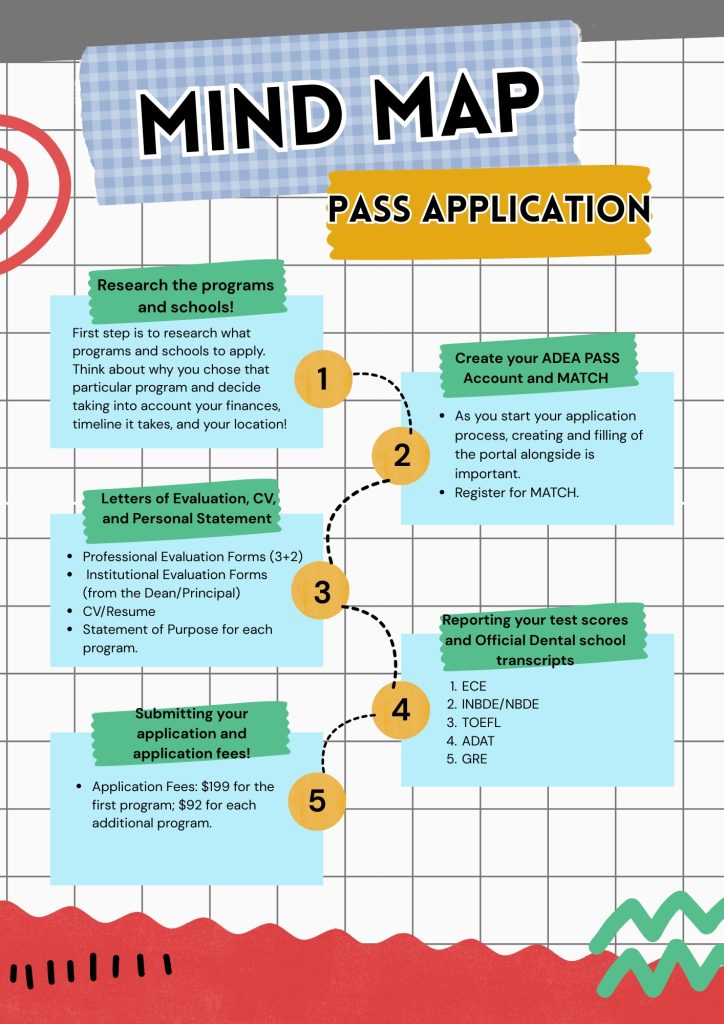
Create your ADEA PASS Account
Create a new account through the ADEA PASS portal. Once you have created your account, you will be given a CAS ID number (which can be seen on the top right of your application). You can provide this number when contacting customer service.
Register for Match (case basis)
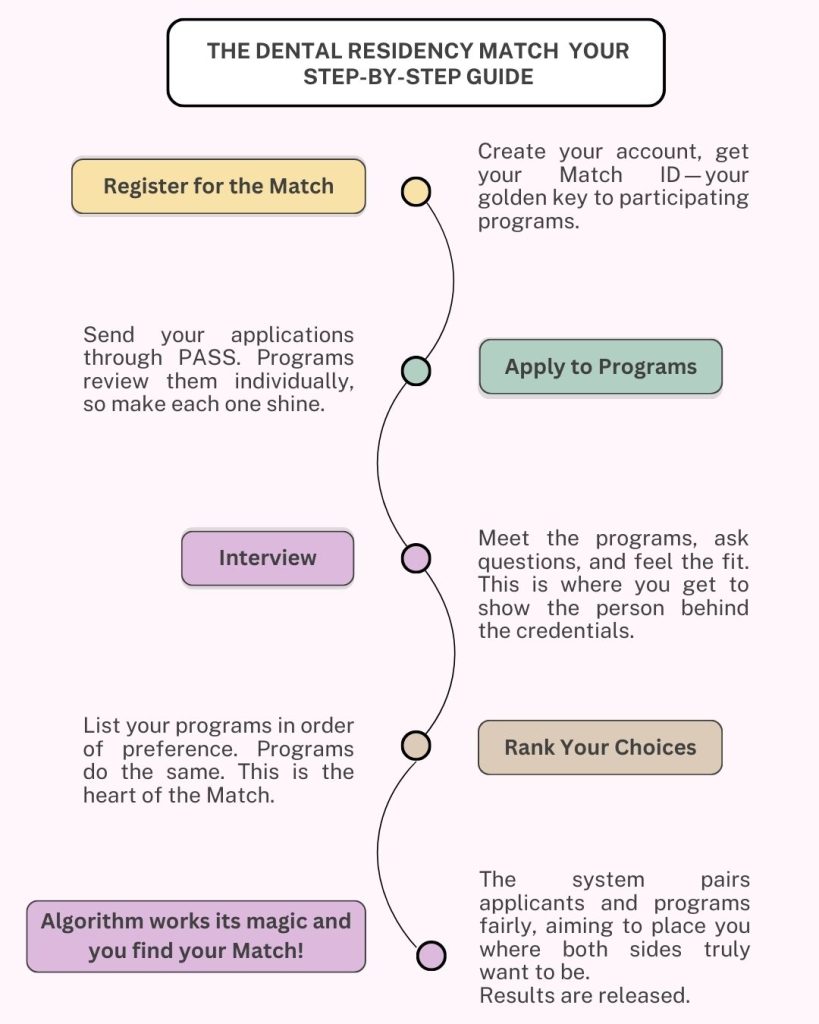
Some dental specialties use the Match to assign applicants to residency programs, a structured system that pairs candidates and programs based on mutual preferences. Think of it as a carefully choreographed dance: you rank the programs you desire, programs rank their applicants, and an algorithm finds the best fit for both. Not every specialty participates. For example, Endodontics does not use the Match, so registration is not required there.
If you are applying to a Match-participating program, it is essential to register and quote your Match ID number in your PASS application. This ensures your application is correctly linked and considered by programs within the Match process. Programs relying on the Match include Orthodontics, Periodontics, Pediatric Dentistry, and others. You can find a complete list of participating programs at Dental Match | Participating Programs.
Why Register for the Match?
Registration allows you to be included in the official pairing process. Without it, even a completed PASS application may not secure a spot, as programs can only consider applicants within the Match system.
How to Register?
- Visit the National Matching Services website.
- Create an account and complete your profile.
- Pay any required fees.
- Obtain your Match ID number and keep it ready for your PASS application.
- Follow instructions for submitting your rank order lists during the designated Match period.
For a clear overview of how the Match algorithm works, you can refer to resources like NRMP Match Algorithm Explained or short summaries such as https://youtu.be/CkwJjWdgafs, https://youtube.com/shorts/kndEbNpdmmE.
Official Test Scores
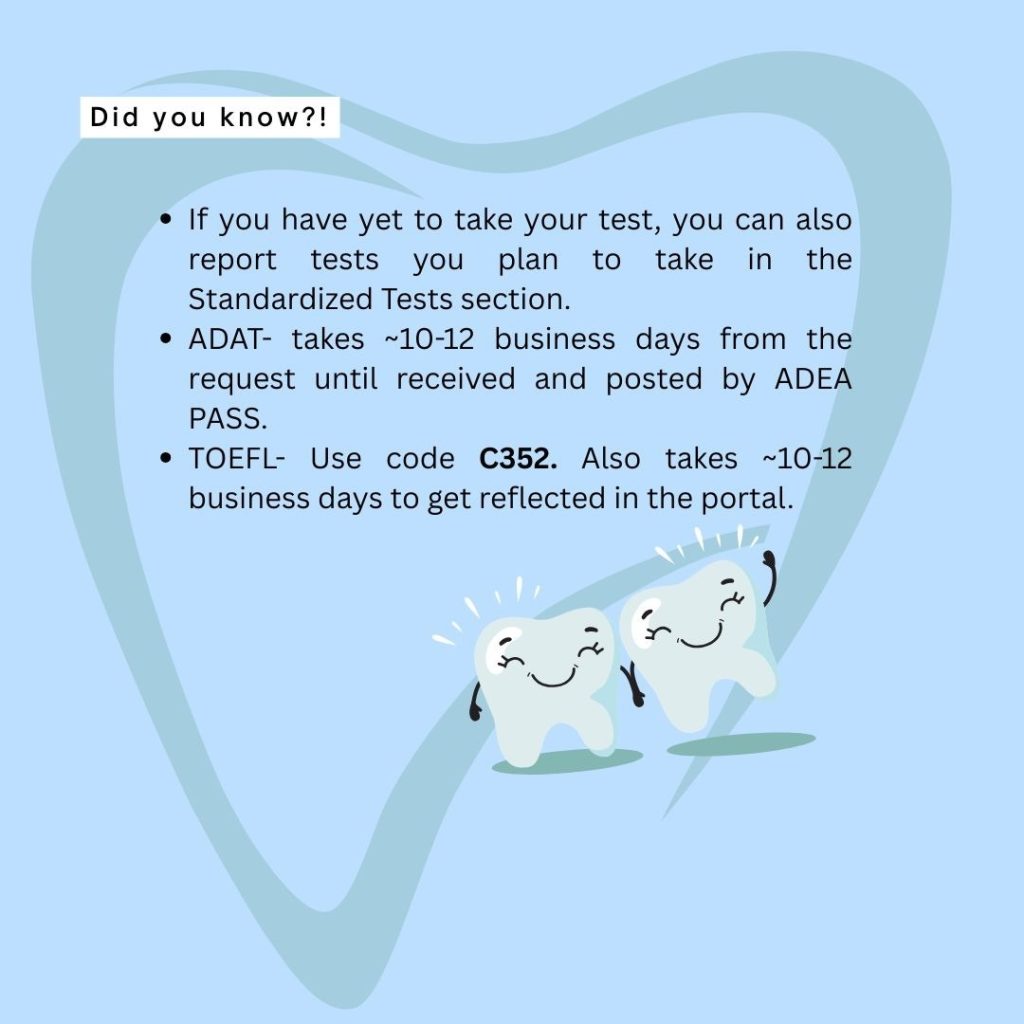
The first rule of any application process is to tackle the things you can’t fully control, like test scores, which often take days to show up. These include your INBDE/NBDE, ADAT, and TOEFL results. Some programs may require the GRE, so be sure to double-check the requirements before requesting your official scores to be sent.
Once you send your official scores, results will be sent to all the programs you have selected in ADEA PASS. Most scores are officially reported, but some programs also accept unofficial scores. You can check these statuses under ‘Check Status’ for official ones and ‘Academic History’ for the unofficial scores.
Official Dental Transcripts and ECE/WES Evaluations
If you studied dentistry outside the United States, most ADEA PASS programs will ask you to have your coursework evaluated by a U.S.-based service. This evaluation, presented as a course-by-course equivalency report, must be sent directly to ADEA PASS by the service itself. Start this step early, as processing can take weeks!
ADEA PASS accepts only electronic foreign evaluations from World Education Services (WES) or Educational Credential Evaluators (ECE). You can request a WES ICAP or ECE course-by-course evaluation directly through your application by first listing your school under Colleges & Dental Schools Attended and then selecting either “Order WES Evaluation” or “Order ECE Evaluation.” Once your evaluation is complete, WES or ECE will send it electronically to ADEA PASS.
Please note:
Please keep in mind that most U.S. dental schools ask for an ECE evaluation of your undergraduate dental transcripts. Be sure to check the specific requirements of each program.
If any of your transcripts are not in English, you will also need an official certified translation, ideally from a member of the American Translators Association.
And remember, never mail foreign transcripts to ADEA PASS, even if they’re already in English or translated; they’ll be discarded.
Evaluation Forms
Now that all official reports are ordered in, it’s time to move on to more specific but qualitative documents – like your Evaluation Forms. Unlike a CAAPID letter of recommendation that is generic, PASS Evaluation Forms have a unique format. You are required to submit,
- One Institution Evaluation Form (IEF) from your Dean/School of Dental Education and
- Three Professional Evaluation Forms (PEF) from mentors who have known you in a professional capacity. You can upload a total of up to five PEFs.
Now, what are these forms? Whom should you reach out to?
- IEF: This is nothing but your Dean’s letter, and it is a mandatory requirement. This form should be filled out by the Dean’s office and includes your class ranking, GPA (if applicable), assessment of your ethical conduct, and other mandatory comments.
- PEF: This is the standard letter of recommendation. It evaluates your personal qualities and professional traits, along with the mandatory comments. Every applicant must submit three PEFs, with the option to include up to two more. Each PEF you submit is shared with all the programs to which you apply.
Things to keep in mind:
- Let your evaluators know that PASS uses a specific form.
- Once you request an evaluation, they will receive an email with a link to Liaison Letters, where they can access and complete the form.
- The PEF invites them to look closely at ten qualities that define a practitioner’s journey: integrity, professionalism, clinical skills, openness to feedback, knowledge, critical thinking, connection with others, organization, self-awareness, and maturity.
- For each, they choose whether you exceed expectations, meet them, or fall short, weaving in brief words as short descriptive comments that bring clarity to their judgment.
- As a last step, evaluators are also required to provide an overall recommendation.
CV
In the Documents section, you’ll upload your CV or résumé. For residency programs, it’s best to keep things crisp —no more than 2-3 pages —and focused on experience. Include your shadowing, volunteer work, research, and work experiences, as well as any other activities that demonstrate the depth of your journey and your readiness for the specialty program and advanced training.
For more details on how a CV should look, check out this blog that outlines what to include, pitfalls to avoid, and how to make your dental CV stand out.
Blog – HOW TO WRITE A DENTAL CV THAT ACTUALLY STANDS OUT
Statement of Purpose
Your personal statement is your chance to step out of the resume and let your story take center stage. It’s where your experiences, ambitions, and character come alive, giving programs a sense of who you are beyond grades and test scores. While you can craft a single statement for all programs, you can also write distinct essays when applying to multiple specialties, whichever best reflects your journey.
PASS offers freedom: no strict character limit, no rigid boxes. But with that freedom comes the need for focus. A sprawling essay can lose its impact, and an overly short one may leave the reader wanting more. The goal is to strike a balance: provide enough detail to convey your experiences and why the program is relevant, but remain concise enough to hold attention.
You can focus on experiences that define your personal and professional growth. Write with clarity, authenticity, and a touch of your own voice. A great personal statement doesn’t just list accomplishments, but invites the reader to get to know the person behind them.
This blog provides you with tips on how to craft a strong PS by highlighting the differences between a CAAPID and a PASS personal statement.
The beauty of a PASS Statement is that, in the PASS Portal, it is to be uploaded in the Program Materials section of each school you are applying to (and not the Supporting Information section). This is a golden opportunity to tailor your statement specifically, according to the specialty and according to the program/school in question. While this is not a deal-breaker, it is still an option you could capitalize on!
And with that final straw, you are all set to click the submit button on the PASS Portal! Yes, some schools do have a few basic supplemental questions, but these are usually not as detailed or lengthy as those from some of the CAAPID schools.
AFTER YOU APPLY
You wait, of course, but this waiting has purpose. It is time to prepare.
Schools begin reaching out for interviews on a rolling basis, not in batches the way CAAPID programs often do. The earlier your application is in, the sooner opportunities begin to open.
Programs want to understand how you think, how you respond, how you learn. They look for coachability, presence, and attitude more than perfect recall. Dr Nourah, our founder, went through ten interviews herself, and each one was different. Some were warm, some intense, some surprising, but all were centered on who she was, not just what she knew.
You will likely be asked why you chose this specialty, why a particular program speaks to you, what you would do if your first plan changes, what strengths you rely on, what weaknesses you are working through, and where you hope this road ultimately leads.
One part of the process matters more than many expect: the time spent with residents. Residents have a real voice in choosing who fits and who does not. They notice sincerity, respect, and ease, just as they notice pushiness, forced conversation, or unsettling behavior. Take your time, move around the room, and speak with many of them. Be present without pressing too hard. Let your genuine self carry the conversation.
For preparation, you can use the same style of practice as CAAPID: behavioral scenarios, ethical reflections, and a small touch of clinical reasoning. Here are a few blogs and videos that can help you with your preparation.
- The Ultimate Guide for US Dental Interview Questions (2023)
- How to Ace your CAAPID & PASS Interviews in just 60 Minutes | Caapid Simplified
- DDS Interviews – Critical Thinking Questions in ADEA- CS
After the Interview
Once interviews are over, the next step is the match.
- Rank your preferred programs.
- Then… wait.
- Match release dates for 2025: Phase 1 on November 19, Phase 2 on January 21.
Once matched, acceptance marks a turning point. There may still be hurdles like visas, loans, graduation requirements, and employment logistics, but by then, your direction is set and steady.
PASS & CAAPID – THE TWO PATHS
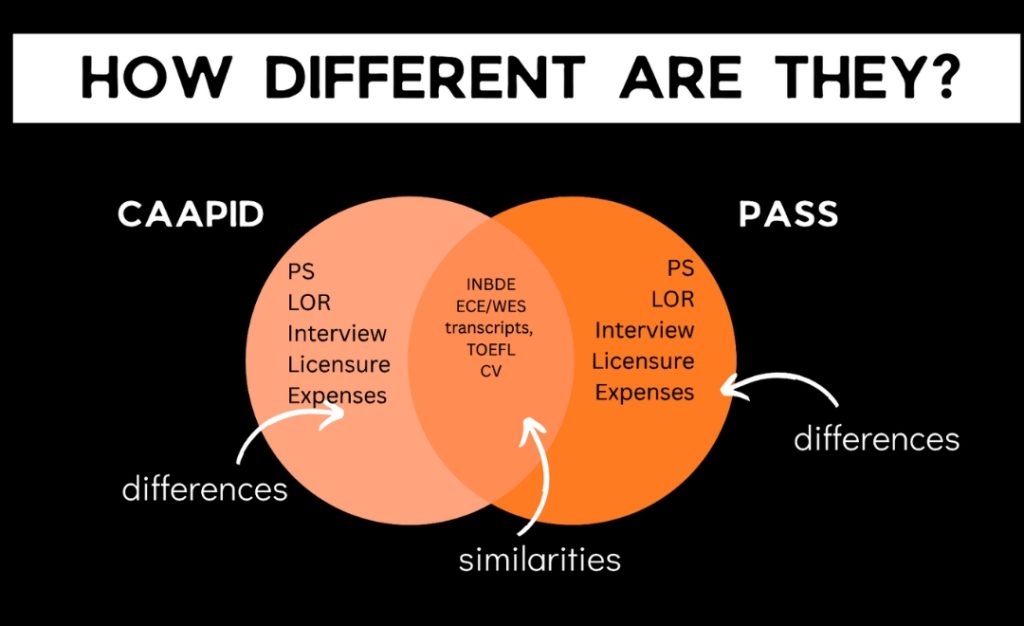
PASS and CAAPID are two roads that diverge from similar beginnings. Both seek to connect you to programs, but the terrain differs:
- PASS lets you focus, match by specialty, and shape your story for each program.
- CAAPID moves broadly, with a more standard path.
- Letters, CVs, and personal statements—they vary in scope, intent, and style.
ATTRIBUTES | CAAPID | PASS |
Personal Statement | The character limit is 5200 characters. One PS can be uploaded in the portal and cannot be tailored specifically to any one school. | No character limit; tailored for individual programs; not submitted on the portal like CAAPID. Disclaimer: Check each program’s requirements! |
Recommendation letters | LORS- 3 (Dean compulsory)+2(additional letters); Exceptions- Indiana, LLU (Volunteering letters) LOR Format: Letter on the school’s/ clinic’s letterhead with signature and seal. | Evaluation forms: 1+3 to 5 letters. One institutional evaluation form (IEF, i.e., Dean’s or Principal’s) and Professional Evaluation forms (PEF). LOR Format: PASS- Qualtrics form. |
Program Specificity | Largely, all school requirements are comparable, except for a few. Examples include Indiana, UoP, and LLU. | Offers around 800 programs countrywide. The requirements for each program are specific, and thorough research is essential. |
Interview Process+ Bench | Some schools are on a rolling basis, but you can still apply until the application closes. | Rolling basis – can be called at any time. The earlier you apply, the better your chances will be. Disclaimer: Early application does not mean an incomplete application Interview – similar to CAAPID, the interview assesses the person’s fit for the program, including behavioral aspects and clinical scenarios. Most programs don’t have a bench, but some AEGD programs do. |
Licensure | You cast a wider net, enabling you to practice across the country, subject to the state licensure requirements. | You may only have a restricted license to practice in that state. You can get this clarified by contacting the State Dental Association and explaining your situation. For example, in Florida, you cannot practice as a dentist unless you hold a DDS/DMD degree, even upon completion of your residency. |
Expenses | CAAPID could set you back by a good USD 200k minimum. | Compared to CAAPID, PASS is slightly less expensive. It might cost you about 20K to 40K (some even pay you a stipend, a nominal amount as a foreign-trained dentist with thousands of dollars in loans, but still, any income is welcome) |
CONCLUSION
So we return to the image we began with. There are two roads opening before you, each with its own terrain, its own promise, and its own price.
Choosing PASS or CAAPID is choosing the direction that aligns with who you are and who you hope to become. One road may be more traveled, the other a little quieter, but the road you choose becomes your own. A road not taken by everyone yet meant for you.
As long as you have a fair idea of what the route entails and are mentally prepared for a few surprises, the journey becomes a memorable one!
Safe travels!
Also Read:-